
Attendance Management & Compliance System
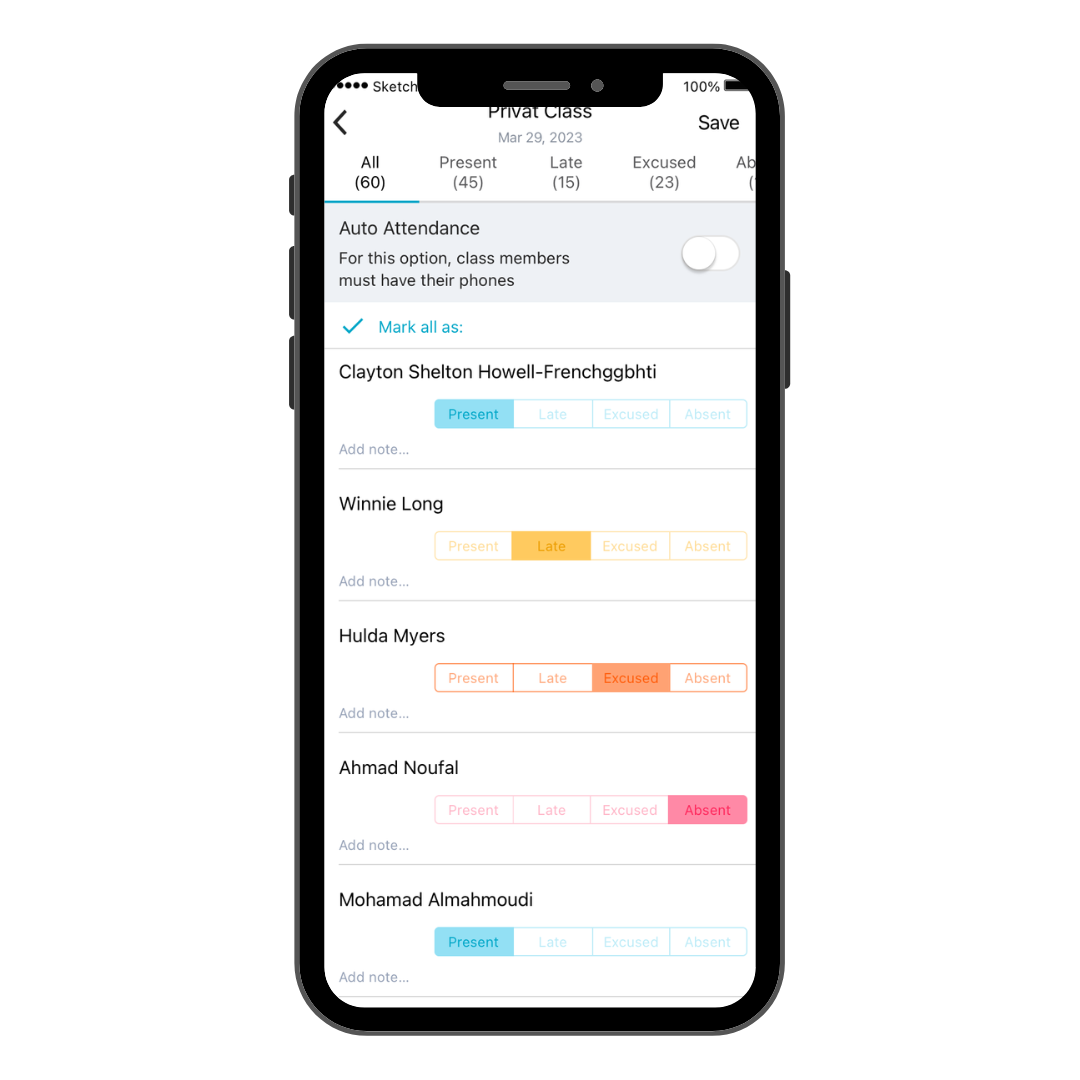
MyU’s Attendance Management & Compliance System enables institutions to track, reconcile, and report attendance at both session and daily levels, with support for time-based tracking, automated attendance capture, and compliance-ready reporting for regulated environments.
🟩 Overview
Attendance is one of the most operationally critical functions in any educational or training environment, yet it is often handled through fragmented processes that rely on manual input, inconsistent rules, and disconnected reporting.
MyU redefines attendance as a structured system rather than a routine task. It transforms how attendance is captured, processed, and validated by introducing a unified model that connects classroom activity, administrative control, and reporting into a single, coherent workflow. The result is a system where attendance data is not only recorded, but also interpreted, verified, and made usable across the institution.
🟥 The Problem It Solves
In most institutions, attendance exists in multiple forms that do not align with each other. Teachers record attendance at the class level, while administrators require a final daily status, and in many cases, these two layers are never properly reconciled.
This leads to inconsistencies, missing records, and a lack of accountability. More importantly, traditional systems are not designed to handle real-world scenarios such as conflicting attendance entries, late recordings, or compliance requirements that depend on tracking actual attendance time rather than simple presence.
MyU addresses these gaps by introducing a system that is designed to handle complexity from the start, rather than forcing institutions to work around limitations.
🟦 How It Works
At its core, MyU’s attendance system operates as a layered model that reflects how attendance actually happens in real environments.
Attendance is first recorded at the session level, where each class or activity generates its own record. This allows teachers to capture attendance in context, tied directly to a specific lesson or session rather than as an abstract daily entry.
From there, the system automatically derives a daily attendance status by aggregating session data. Instead of relying on manual consolidation, MyU applies defined logic to determine the most accurate representation of a student’s attendance for the day. When multiple sessions exist, the system evaluates them together and identifies any inconsistencies.
Administrative control is then applied as a final layer. Authorized users can review, override, and finalize attendance records where necessary. Every change is tracked, ensuring that the system maintains both flexibility and accountability.
🟪 Time-Based Attendance Tracking
While many systems stop at marking students as present or absent, MyU extends attendance into a time-based model that records the actual duration of participation.
This includes tracking when a session starts, when it ends, and how long a student was present, including any defined breaks. By capturing attendance as time rather than a binary status, the system becomes suitable for environments where participation hours matter.
This is particularly important for regulated training programs such as aviation or certification-based education, where institutions must demonstrate not just attendance, but the exact number of hours completed. MyU enables these institutions to maintain accurate logs that can be used for compliance, reporting, and audits without requiring external systems.
🟧 Automation & Efficiency
One of the biggest inefficiencies in traditional attendance processes is the time spent both during and after class managing records. Teachers often lose valuable instructional time taking attendance, while administrative teams spend additional time consolidating and organizing the data.
MyU reduces this overhead significantly by introducing automation into the process. Attendance can be recorded in seconds, and once captured, it is immediately available across the system without the need for manual compilation. Reports are generated in real time, allowing administrators to access accurate data whenever needed without delays.
This shift from manual handling to automated processing not only saves time but also reduces the likelihood of human error.
🟫 Reconciliation & Exception Handling
Real-world attendance is rarely clean or perfectly consistent. There are always edge cases—sessions where attendance was not recorded, conflicting entries across multiple classes, or discrepancies between class-level and daily records.
MyU is designed to handle these scenarios explicitly. Instead of ignoring inconsistencies, the system detects and surfaces them, allowing administrators to review and resolve issues in a structured way. Whether it is a missing session record or a mismatch between different attendance entries, the system ensures that no inconsistency goes unnoticed.
This approach turns attendance from a passive record into an actively managed dataset, where accuracy is continuously maintained rather than assumed.
🟨 Reports & Outputs
Once attendance data is structured and validated, MyU makes it accessible through a range of reports that serve different operational needs.
Institutions can view final daily attendance statuses for quick overviews, analyze session-level data for deeper insights, and generate exception reports that highlight inconsistencies or missing records. For compliance-focused environments, time-based attendance logs can be exported and used for audits or regulatory reporting.
Because all reports are generated from a unified data model, institutions can trust that the information they are using is consistent across all levels.
🟩 Use Cases
In schools, MyU simplifies daily attendance tracking while providing parents and administrators with clear visibility into student presence. The system reduces administrative burden while improving accuracy and transparency.
In training institutes and regulated environments, the ability to track attendance based on time enables institutions to meet compliance requirements without additional tools. Detailed logs and audit-ready records ensure that attendance data can withstand external scrutiny.
In corporate training contexts, attendance becomes a measurable component of participation, allowing organizations to track engagement and link it to certification or performance outcomes.
🟦 Integration with the Platform
Attendance in MyU does not exist in isolation. It is tightly connected to the rest of the platform, drawing student data from the SIS, feeding into analytics and reporting, and triggering communication workflows when needed.
This interconnected design ensures that attendance is not just recorded, but actively used across the system to support decision-making and operations.
🟫 Security & Control
Given the sensitivity of attendance data, MyU applies strict access controls to ensure that only authorized users can view or modify records. Administrative actions, such as overrides or adjustments, are fully tracked, creating a clear audit trail.
This combination of controlled access and traceability ensures that attendance data remains both secure and accountable.