
Student Information System (SIS)
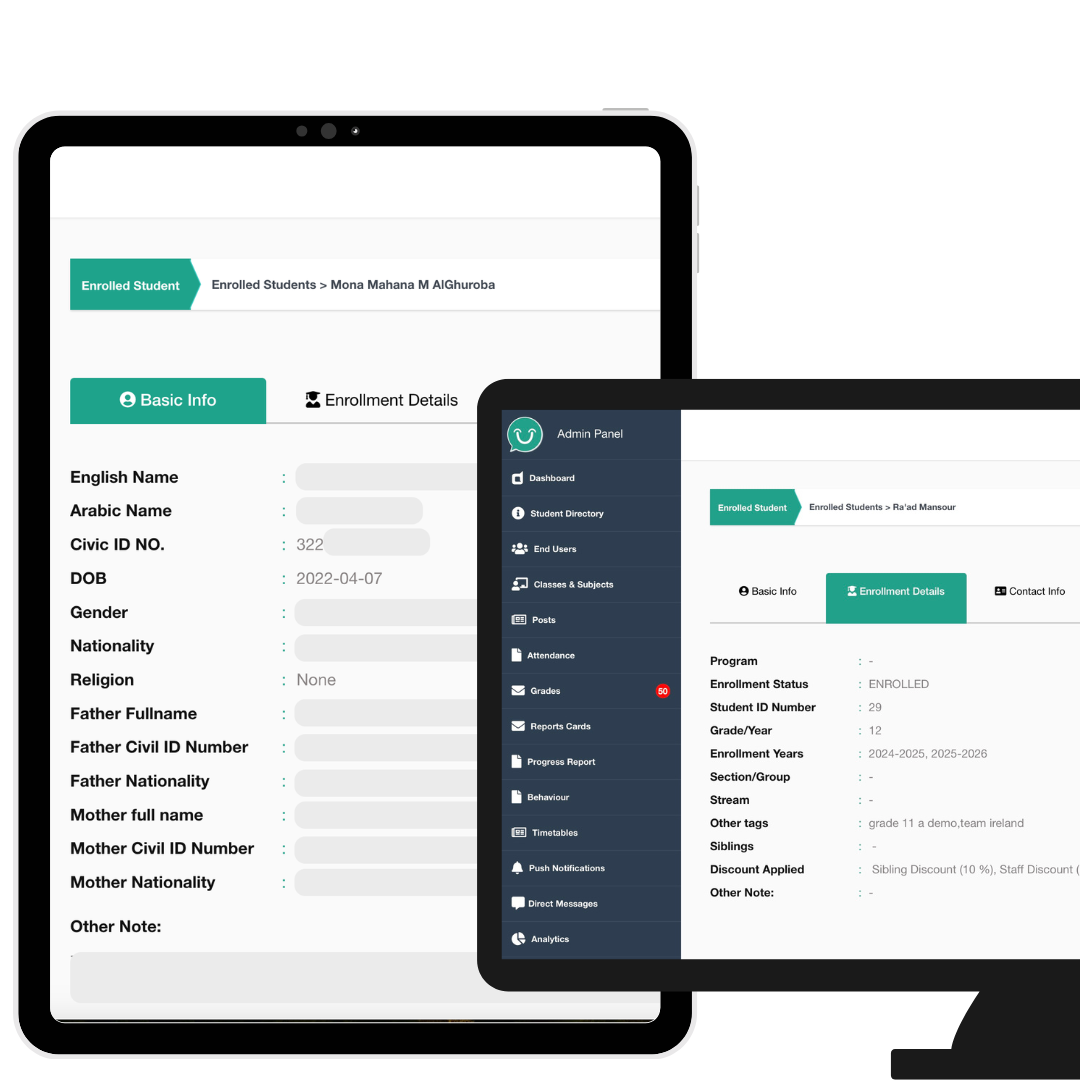
MyU’s Student Information System (SIS) serves as the central data layer for managing student records, enrollment, academic information, and institutional data—powering all operational, academic, and communication workflows across the platform.
🟩 Overview
At the core of every educational institution lies a single, critical dependency: accurate and well-structured student data. Whether it is attendance, grading, communication, or reporting, every function relies on a consistent understanding of who the student is, where they belong, and how they progress through the system.
In many institutions, this data is fragmented across spreadsheets, disconnected systems, and manual processes. This fragmentation leads to inconsistencies, duplication, and inefficiencies that affect every layer of operations.
MyU addresses this by establishing a centralized Student Information System that acts as the single source of truth. Instead of treating data as a background component, the platform places it at the center of all workflows, ensuring that every module operates on the same structured foundation.
🟥 The Problem It Solves
Without a unified data system, institutions face persistent challenges in maintaining accuracy and consistency. Student records are often duplicated across different tools, enrollment processes are handled manually, and updates are not reflected uniformly across systems.
This lack of synchronization creates downstream issues. Attendance records may not align with class lists, grading may be applied to outdated student data, and communication may reach the wrong audience or miss key recipients entirely.
MyU resolves these issues by consolidating all student data into a single, structured system where updates are reflected instantly across the entire platform.
🟦 How It Works
The SIS in MyU is built as a structured data system that connects student identity, enrollment, and academic organization into a unified model.
Each student is assigned a dedicated digital profile that stores all relevant information, including personal details, academic placement, and supporting records. These profiles are not static entries but dynamic records that evolve as students progress through the institution.
Enrollment is handled through an integrated system that allows institutions to onboard students efficiently and assign them to the appropriate classes and grade levels. Once enrolled, students are automatically reflected across all relevant modules, ensuring consistency without requiring repeated data entry.
To support operational needs, the system also provides structured ways to organize and access data. Institutions can filter students by grade level, academic year, or class grouping, making it easier to retrieve information and generate reports without manual sorting.
🟪 Central Data Layer
The SIS functions as the backbone of the MyU platform. Every other module depends on it to operate correctly.
Attendance systems rely on SIS data to determine which students belong to each class. Grading systems use it to link evaluations to the correct individuals and academic structures. Communication tools depend on it to define groups and channels, while analytics systems draw from it to generate accurate insights.
By centralizing all data within the SIS, MyU ensures that every part of the platform operates on a consistent and reliable foundation. This eliminates discrepancies and allows institutions to trust the data they use for decision-making.
🟧 Enrollment & Rostering
Managing student enrollment and class assignments is often one of the most time-consuming administrative tasks. MyU simplifies this process through tools designed for both efficiency and accuracy.
Institutions can upload student data in bulk, reducing the need for manual entry. Once data is imported, the system supports automatic rostering, assigning students to their respective classes based on defined structures.
This approach ensures that class lists are always aligned with enrollment data, reducing errors and saving time for administrative staff. Updates to enrollment are reflected immediately across the system, maintaining consistency without additional effort.
🟫 Data Structure & Organization
A key strength of the SIS is its ability to organize data in a way that reflects how institutions operate.
Students can be grouped and filtered based on multiple dimensions, including grade level, academic year, and class structure. This allows administrators and educators to access relevant data quickly, whether they are managing a specific class or analyzing performance across an entire grade.
By structuring data in this way, MyU enables institutions to move from reactive data handling to proactive data management.
🟨 Automation & Efficiency
The SIS reduces administrative workload by automating routine processes and minimizing redundant tasks.
Bulk operations allow institutions to update large datasets quickly, while automated calculations—such as deriving information from existing fields—reduce the need for manual adjustments. Because all modules draw from the same data source, updates made in one place are instantly reflected across the platform.
This level of automation not only improves efficiency but also ensures that data remains consistent and up to date at all times.
🟩 Data Accuracy & Consistency
One of the most significant advantages of a centralized SIS is the elimination of conflicting data. When all modules rely on the same source, there is no risk of discrepancies between attendance records, grading data, or communication groups.
This consistency is essential for generating reliable reports, maintaining accurate records, and supporting informed decision-making. Institutions can operate with confidence, knowing that their data reflects reality across all systems.
🟦 Use Cases
In schools, the SIS simplifies enrollment management, maintains comprehensive student records, and ensures that all academic and operational systems are aligned.
In multi-campus institutions, it enables centralized oversight of student data while allowing each campus to manage its own operations within a shared framework.
In nurseries, the system supports the tracking of developmental and medical information, providing a structured record for each child.
In training institutes, it allows organizations to manage participant data across different programs, ensuring that enrollment and progress are consistently tracked.
🟧 Integration with the Platform
The SIS is deeply integrated with every component of MyU. It supplies the foundational data used by attendance tracking, grading systems, communication channels, and analytics.
This integration ensures that all workflows are connected and that data flows seamlessly across the platform. Instead of operating as isolated features, each module becomes part of a unified system built on a shared data foundation.
🟫 Security & Access Control
Given the sensitivity of student information, MyU applies strict access controls to ensure that data is only available to authorized users. Permissions are defined through the platform’s administrative system, allowing institutions to control who can view or modify specific types of information.
This ensures that student data remains secure while still being accessible to those who need it for operational and academic purposes.
🟨 Scalability
As institutions grow, their data management needs become more complex. MyU’s SIS is designed to scale with this growth, supporting everything from small schools to large education networks with multiple campuses.
The system’s flexible structure allows institutions to expand without needing to reorganize their data or adopt additional tools, ensuring long-term sustainability.